

Is That Really Them? How to Detect Deepfake Audio Scams | 2026
Deepfake audio and AI voice scams represent the most frightening evolution in modern cybercrime. Scammers are no longer just trying to guess your passwords, crack your bank accounts, or trick you...


Deepfake audio and AI voice scams represent the most frightening evolution in modern cybercrime. Scammers are no longer just trying to guess your passwords, crack your bank accounts, or trick you with generic phishing emails; they are successfully hijacking the very sound of the people you love most. With the rapid advancement of artificial intelligence, threat actors can now synthesize highly convincing audio replicas of anyone’s voice, turning a mundane phone call into a high-stakes psychological attack. Imagine picking up the phone and hearing the panicked, unmistakable voice of your spouse or child begging for help. The terror is real, the voice sounds authentic, but the person on the other end is entirely synthetic. This is not a futuristic science fiction scenario; it is the reality of digital fraud in 2026.
Table Of Content
- Quick Answer: What is a Deepfake Audio Scam?
- How Do AI Voice Cloning Scams Work?
- The Three-Second Rule
- The Attack Execution Process
- Examples of Deepfake Audio Frauds in 2026
- The “I Had an Accident” Family Emergency Call
- The Virtual Kidnapping and Fake Ransom
- Corporate Fraud and Bank Authority Bots
- Is Voice Filter Safe to Use?
- The Hidden Data Harvesting Economy
- Reading the Fine Print: Privacy Policies
- How to Detect AI Voice Cloning Scams
- 1. Metallic Glitches and Robotic Artifacts
- 2. Unnatural Pacing and Latency Issues
- 3. Emotionless Tone During High-Stress Claims
- 4. Bizarre Phrasing and Unexpected Vocabulary
- Protecting Your Family from Deepfake Voice Call
- Causes and Vulnerabilities: How We Expose Ourselves
- Oversharing on Public Profiles
- The illusion of Caller ID Security
- Lack of Authentication in Financial Transactions
- Tools and Methods to Defend Against Voice Spoofing
- 1. Telecom-Level Call Screening
- 2. Zero-Trust Communication Verification
- 3. Digital Footprint Minimization
- Expert Insights on the Future of Deepfake Audio
- Frequently Asked Questions (FAQ)
- The Ultimate Solution to Deepfake Audio and AI Voice Scams
To protect your finances, your data, and your family’s peace of mind, you must understand how this technology is weaponized. This comprehensive guide will break down exactly how cybercriminals clone voices, the most common fraud scenarios actively targeting victims today, the hidden dangers of popular audio apps, and the precise, actionable steps you can take to identify and stop a synthetic audio attack before it is too late.
If a highly convincing deepfake call successfully tricked you into handing over sensitive personal information or passwords, your entire digital identity is now at risk. Do not wait for the scammers to strike again. To assess the full scope of a potential breach and secure your accounts immediately, follow our comprehensive guide: How to Know If You’ve Been Hacked | Complete 2026 Guide.
Quick Answer: What is a Deepfake Audio Scam?
Deepfake audio scams are targeted cyberattacks where criminals use artificial intelligence software to clone a person’s voice with extreme accuracy. By analyzing just a few seconds of publicly available audio, scammers can type text into a computer and have the AI speak those words aloud in the victim’s exact tone, pitch, and accent. These cloned voices are then used to bypass biometric security systems, execute corporate wire fraud, or extort money from terrified family members who believe their loved one is in immediate danger.
How Do AI Voice Cloning Scams Work?
Understanding the mechanics of an attack is the first step in defending against it. In the past, voice impersonation required a skilled human mimic and a lot of luck. Today, it requires nothing more than an internet connection and a malicious intent. The barrier to entry for cybercriminals has completely collapsed, giving rise to “crime-as-a-service” platforms on the dark web where anyone can purchase voice-cloning capabilities.
You might be wondering how these AI scammers know exactly who to call and what personal details to mention to make their stories believable. The harsh reality is that this information is usually harvested from massive dark web databases. Find out if your contact details are actively fueling these targeted attacks by reading How to Check if Your Email Was Leaked.
The Three-Second Rule
The most chilling aspect of modern voice synthesis is how little data the algorithms actually need. A few years ago, training an AI to replicate a human voice required hours of clean, studio-quality audio. In 2026, state-of-the-art AI models require as little as three seconds of audio to create a highly accurate clone. Where do scammers get this audio? The answer is likely sitting on your phone right now.
- Social Media Scraping: Instagram reels, TikTok videos, and YouTube shorts are goldmines for threat actors. If your profile is public, a scammer can download a video of you speaking, extract the audio track, and feed it directly into a cloning engine.
- Professional Profiles: Corporate introduction videos, podcast guest appearances, and LinkedIn audio pronunciations are frequently targeted to clone the voices of executives and business owners.
- Voicemail Greetings: Even a simple “Hi, you’ve reached John, please leave a message” can provide enough phonetic data for an advanced neural network to map the unique characteristics of your speech.
The Attack Execution Process
Once a cybercriminal has obtained your audio fingerprint, the execution of the scam follows a systematic, highly orchestrated pipeline.
- Audio Isolation: The attacker uses automated tools to strip away background noise, music, or wind from the stolen social media clip, leaving only the pure vocal track.
- Model Training: The isolated voice is fed into a neural network. The AI analyzes the individual’s cadence, breath patterns, pitch, and unique phonetic pronunciations.
- Target Selection: Scammers use data brokers and public records to map the victim’s family tree or corporate hierarchy. They identify who the cloned voice holds the most influence over—usually a parent, grandparent, or subordinate employee.
- The Live Scripting: During the actual phone call, the scammer uses a text-to-speech (TTS) interface. As they type out extortion demands or instructions to wire money, the software instantly generates the audio in the cloned voice and pipes it directly into the phone line.
- Spoofing the Caller ID: To add a final layer of legitimacy, attackers use caller ID spoofing software so the incoming call appears to legitimately originate from the cloned individual’s actual phone number.
Examples of Deepfake Audio Frauds in 2026
The versatility of synthetic audio means criminals can tailor their attacks to exploit different psychological triggers. While the underlying technology remains the same, the execution varies wildly depending on whether the target is an individual or a multinational corporation.
Deepfake audio attacks almost exclusively target you on your smartphone, often attempting to trick you into clicking malicious SMS links or exposing two-factor authentication codes while distracted on the call. If you recently interacted with a suspicious caller and feel your device’s security has been compromised, discover the crucial red flags in Signs Your iPhone is Hacked | 2026 Update.
The “I Had an Accident” Family Emergency Call
This is currently the most devastating and widespread iteration of the attack. Criminals target parents and grandparents, leveraging the innate human instinct to protect family members.
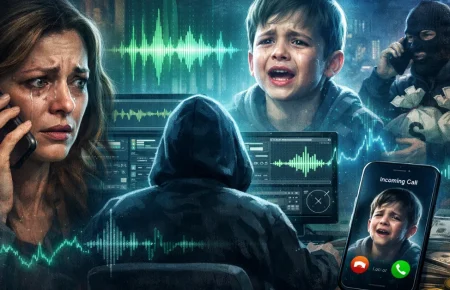
- The Scenario: A parent receives a call late at night. The caller ID shows their son’s phone number. When they answer, they hear their son frantically screaming that he has been in a terrible car accident, hit a pregnant woman, and is currently being held in a foreign jail or by aggressive local authorities.
- The Hook: The “son” pleads for immediate bail money or a payoff to avoid arrest. The call is then abruptly handed over to a “police officer” or “lawyer” (usually the actual human scammer) who provides instructions for wiring cryptocurrency or sending funds via Zelle.
- Why it Works: Fear overrides critical thinking. When you hear your child crying in pain or terror, the brain’s amygdala triggers a fight-or-flight response. The victim does not stop to analyze the audio fidelity; they simply react.
The Virtual Kidnapping and Fake Ransom
A darker evolution of the emergency scam is the virtual kidnapping. These attacks are meticulously researched and timed for maximum psychological impact.
- The Scenario: A mother receives a call from an unknown number. Instead of a greeting, she hears her daughter crying and begging not to be hurt. A harsh voice then cuts in, claiming to have kidnapped the daughter and demanding an immediate, untraceable ransom payment.
- The Hook: The scammers often track the actual daughter’s location via social media check-ins or compromised data. They wait until she is in a movie theater, on a flight, or in a dead zone where she cannot immediately answer her phone to verify her safety.
- Why it Works: The inability to reach the loved one combined with the incredibly realistic audio of their suffering creates a perfect storm of panic, forcing rapid compliance.
Corporate Fraud and Bank Authority Bots
While emotional manipulation works well on individuals, financial institutions and corporate enterprises are targeted through sophisticated authority spoofing.
- The Scenario: An accounts payable manager receives a voicemail from the company’s CEO. The voice is authoritative, using the CEO’s exact cadence and standard corporate buzzwords. The CEO requests an urgent, confidential wire transfer to a new vendor to secure an unannounced acquisition.
- The Bank Fraud Angle: Scammers also use cloned voices to bypass bank voice-authentication systems. By playing a synthetic clone of a wealthy client to an automated banking portal, they can authorize password resets, access account balances, or initiate unauthorized transfers.
Is Voice Filter Safe to Use?
As artificial intelligence has integrated into consumer software, thousands of “fun” audio manipulation tools have flooded app stores. These range from celebrity voice changers to apps that make you sound like an alien, a robot, or a cartoon character. While these apps seem like harmless entertainment, they represent a massive, poorly regulated vulnerability.
One of the most common goals of a deepfake voice scam is to induce panic, convincing you to install “remote support” software on your personal computer to fix a fabricated issue. If an AI-generated caller successfully persuaded you to download anything onto your Windows machine, you need to urgently check for the 10 Hidden Symptoms of Malware on Your Laptop.
If you are not paying for the product, you are the product. This age-old tech adage is especially true for free voice filter applications.
The Hidden Data Harvesting Economy
When you download a free voice modifier, the app requires microphone permissions. What most users fail to realize is that the audio processing rarely happens locally on your device. Instead, your voice recordings are uploaded to the developer’s cloud servers.
Once your voice data is on their servers, it becomes a highly valuable commodity.
Reading the Fine Print: Privacy Policies
The danger lies buried in the Terms of Service and Privacy Policies that 99% of users blindly accept. Many of these applications contain broad, sweeping clauses that grant the developer a perpetual, irrevocable, worldwide license to use, modify, and distribute your voice data.
- Training Fodder: App developers frequently sell massive datasets of human voices to larger AI companies to help train next-generation audio generation models. Your unique vocal traits become part of a global algorithmic machine.
- Third-Party Sharing: Ambiguous privacy policies often state that data may be shared with “trusted partners for marketing and analytics.” In the murky world of data brokering, these partners can include entities with lax security standards, making your voice data vulnerable to breaches.
- Lack of Deletion Protocols: Even if you delete the app from your phone, your voice recordings remain securely stored on remote servers. Very few free applications offer a genuine mechanism for users to request the permanent deletion of their biometric data.
Before using any application that records or modifies your voice, you must scrutinize the privacy policy. If the company does not explicitly state that audio is processed locally and permanently deleted immediately after use, you should assume your voice is being monetized and archived.
How to Detect AI Voice Cloning Scams
Despite the terrifying realism of modern synthetic audio, the technology is not infallible. AI generation still struggles with the complex, nuanced mechanics of human speech and raw emotion. If you know what to listen for, you can often identify a deepfake before becoming a victim.
When you receive a suspicious, high-stress phone call, force yourself to pause for three seconds and actively analyze the audio quality. Look for the following critical symptoms of a spoofed call.
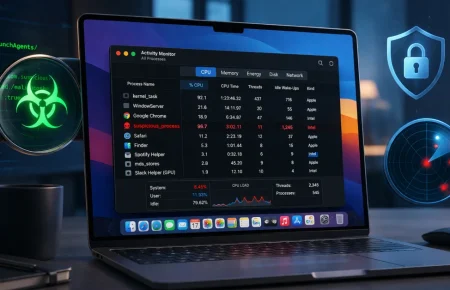
For Apple users, the threat of fake technical support calls is equally dangerous. If you fear a sophisticated voice scammer manipulated you into installing spyware on your MacBook, you must act fast before they drain your bank accounts. Discover how to manually hunt down these hidden threats using our tutorial: Check Malware Activity Monitor Mac | 5 Quick Steps to Stop Threats.
1. Metallic Glitches and Robotic Artifacts
AI struggles to render the precise frequencies of human vocal cords perfectly. Listen closely to the edges of words and the spaces between sentences.
- The Symptom: You may hear a faint, underlying metallic buzz, static, or a hollow “tin can” echoing effect.
- Why it Happens: This occurs because the neural network is mathematically guessing the sound wave transitions. When the algorithm miscalculates, it results in audible digital artifacts that no human throat could produce naturally.
2. Unnatural Pacing and Latency Issues
Deepfake audio requires computing power. Even the fastest text-to-speech engines require a fraction of a second to process the scammer’s typed text and render the audio over the cellular network.
- The Symptom: There will be unusual, slightly too-long delays before the caller responds to your questions. Furthermore, the pacing of the words may feel unnaturally steady.
- Why it Happens: Humans use filler words (“um,” “uh,” “like”), we stutter, we breathe heavily when panicked, and we naturally interrupt each other. AI text-to-speech engines often read sentences in a linear, uninterrupted flow. If the caller is supposedly in a life-or-death panic but their speech lacks natural gasps for air, you are likely speaking to an algorithm.
To create a hyper-realistic deepfake, cybercriminals need high-quality audio recordings of your actual voice. Alarmingly, they often obtain these initial samples by infiltrating unsecured smart speakers and indoor cameras right inside your living room. Protect your household’s privacy and stop scammers from harvesting your audio by learning the Signs Your Smart Home Hacking Symptoms | IoT Devices Are Hacked.
3. Emotionless Tone During High-Stress Claims
Creating a cloned voice is easy; infusing it with genuine, raw, contextual emotion is incredibly difficult.
- The Symptom: The words coming out of the phone describe absolute terror, but the pitch and tone of the voice remain remarkably flat, conversational, or only mildly agitated.
- Why it Happens: Most AI models are trained on podcasts, corporate videos, or relaxed social media content. The AI knows how the person sounds when they are calm. When the scammer types “Please help me, I’m bleeding,” the AI attempts to apply a panicked inflection, but it often defaults back to the calm, baseline training data, creating a deeply unsettling, emotionless delivery.
4. Bizarre Phrasing and Unexpected Vocabulary
Pay attention not just to how they speak, but what they are saying.
- The Symptom: Your “spouse” refers to you by your formal first name instead of a usual pet name. Your “child” uses overly formal language or syntax they have never used in real life.
- Why it Happens: The AI is only generating the voice; a foreign scammer is writing the script. The attacker does not know your family’s inside jokes, slang, or natural conversational rhythm.
Protecting Your Family from Deepfake Voice Call
Recognizing the technical flaws in synthetic audio is helpful, but in the heat of a terrifying emergency call, your analytical brain will likely shut down. You need a foolproof, low-tech system established in advance to cut through the panic.
The Absolute Best Defense is the Family Safe Word.
Just as families have fire escape plans, every modern family must have a digital communication protocol.
- Choose the Word: Sit down with your spouse, children, and elderly parents and agree on a highly specific, random safe word. It should be something that would never naturally come up in conversation (e.g., “Yellow Submarine,” “Tangerine Protocol,” or a specific obscure inside joke).
- Keep it Offline: Never text or email the safe word. Never mention it on social media. It must remain strictly analog.
- The Execution: If you receive a call from a family member claiming to be in an emergency, demanding money, or acting completely out of character, interrupt them immediately. Say: “I need you to tell me the safe word right now.”
- The Result: If the caller hesitates, tries to deflect (“I don’t have time for games, I’m bleeding!”), or guesses incorrectly, hang up the phone instantly. A scammer, regardless of how perfect their AI voice clone is, cannot pull a secret password out of thin air.
The “Hang Up, Call Back” Rule:
If a safe word is not established, immediately execute the call-back protocol. Hang up the suspicious call. Do not redial the number from your recent calls list (as it may be spoofed). Open your contacts app and dial your family member’s actual, saved phone number. 99% of the time, they will answer safely from their office or school, completely unaware that someone is using their cloned voice to extort you.
Causes and Vulnerabilities: How We Expose Ourselves
Cybercriminals rely on the massive, uncontrolled digital footprints most people leave behind. By understanding the root causes of our vulnerability, we can systematically reduce our exposure to deepfake audio attacks.
Oversharing on Public Profiles
The primary cause of voice cloning is unrestricted access to high-quality audio. Many professionals and teenagers alike leave their Instagram, TikTok, and Facebook profiles completely public to maximize engagement. Every vlog, every story update, and every talking-head video is ammunition for an attacker. If your voice is publicly accessible, you are inherently vulnerable.
The illusion of Caller ID Security
A major reason these scams succeed is our blind trust in cellular networks. We have been conditioned for decades to believe that if the screen says “Mom Calling,” it is actually Mom. The telecom infrastructure, specifically the SS7 signaling protocol, is notoriously vulnerable to caller ID spoofing. Scammers use easily accessible Voice over IP (VoIP) software to manually type in the phone number they want to appear on your screen. The cause of the successful deception is not just the voice, but the compromised trust in the telecom system.
Lack of Authentication in Financial Transactions
In corporate environments, the cause of deepfake success is often a lack of strict payment protocols. If an employee can authorize a $50,000 wire transfer based solely on a phone call or a voicemail from the CEO, the company’s security architecture is fundamentally broken. AI voice scams exploit the absence of multi-factor authentication (MFA) in human processes.
Tools and Methods to Defend Against Voice Spoofing
While technology created this problem, specific tools and methodological frameworks can help mitigate the risk. You must layer your defenses, combining software solutions with strict behavioral protocols.
1. Telecom-Level Call Screening
Do not rely on your raw ear to filter out scammers. Use software designed to block spoofed numbers before they ever ring your device.
- Carrier Verification Protocols: Ensure your mobile carrier supports STIR/SHAKEN framework. This is an industry-standard technology that verifies the caller ID information against the actual origin of the call. If a call is spoofed, the network will flag it as “Scam Likely” or block it entirely.
- Third-Party Spam Blockers: Utilize reputable call screening applications. These tools maintain massive, real-time databases of known scam originating IP addresses and VoIP gateways, automatically intercepting fraudulent calls.
2. Zero-Trust Communication Verification
Adopt a “Zero-Trust” mindset for all urgent or financial communications.
- Out-of-Band Authentication: If someone asks for money or sensitive information over the phone, verify the request through a completely different channel. If they call you, hang up and text them. If they email you a voice memo, call them. Forcing the attacker to compromise two separate communication channels simultaneously is incredibly difficult.
- Corporate Duo-Approval Systems: For businesses, implement a strict policy that no financial transaction can be initiated via voice command alone. Require a secondary digital sign-off in a secure internal portal (like Slack or Microsoft Teams) before any funds are moved.
3. Digital Footprint Minimization
You cannot completely erase your voice from the internet, but you can severely limit a scammer’s access to it.
- Audit Social Media Privacy: Lock down personal social media accounts. Change settings to “Friends Only.” If you must maintain a public profile for business, avoid posting long, clear audio monologues unless absolutely necessary.
- Voicemail Security: Re-record your voicemail greeting to be as brief as possible, or use the automated robotic voice provided by your carrier. Do not give attackers a pristine, high-fidelity sample of your voice speaking clearly into a microphone.
Expert Insights on the Future of Deepfake Audio
As a cybersecurity researcher, I can tell you that the window to easily detect these scams is rapidly closing. The advice to “listen for robotic glitches” is effective today, but it may be entirely obsolete by 2028.
The Generative AI Arms Race
We are currently in a volatile arms race between offensive generative AI and defensive detection algorithms. Currently, companies are developing software that analyzes the imperceptible micro-fluctuations in audio waves to determine if a voice was generated by a human throat or a computer processor. However, the moment a reliable detection tool hits the market, threat actors feed its parameters back into their neural networks, training their next-generation models to bypass that specific detection method.
The Rise of Real-Time Video Deepfakes
The next frontier of this threat will move beyond audio. We are already seeing the early stages of real-time deepfake video calls. Attackers will not just spoof a phone number; they will intercept a FaceTime or Zoom call, overlay a hyper-realistic digital mask of your loved one onto their face, and perfectly sync the deepfake audio to the synthetic mouth movements.
The Psychological Paradigm Shift
The most crucial expert advice is not technical, but psychological. We must fundamentally permanently alter how we establish trust. For the entirety of human history, hearing a recognizable voice was the ultimate proof of identity. That era is over. Moving forward, the sound of a voice can only be treated as a claim of identity, not proof of identity. Trust must be established through cryptographic keys, safe words, and multi-factor verification, never solely by our eyes and ears.
Frequently Asked Questions (FAQ)
Can anyone clone my voice, or do they need special software?
While highly specialized, enterprise-grade software exists, the tools required to clone a voice are now widely accessible to the public. Open-source repositories and dark web forums host user-friendly applications where anyone with a basic laptop and three seconds of your audio can generate a highly convincing deepfake in minutes.
Do banks still use voice recognition for security, and is it safe?
Some financial institutions still utilize biometric voice printing to verify customers over the phone. However, in 2026, security experts widely consider voice authentication to be highly vulnerable. Many banks are actively phasing out voice IDs in favor of secure push notifications or physical hardware tokens due to the rise of deepfake bypassing techniques.
What should I do if I realize I am speaking to an AI voice clone?
Do not engage, do not threaten the caller, and do not attempt to gather information. Hang up the phone immediately. Once disconnected, immediately call the actual person the scammer was impersonating using their known, saved phone number to verify their safety. Finally, report the incident to local authorities and the FTC.
Can deepfake audio be used in court as evidence?
The legal system is currently struggling to adapt to synthetic media. While audio recordings are still submitted as evidence, defense attorneys increasingly challenge their authenticity. Digital forensics experts must now be brought in to analyze the metadata and spectral frequencies of audio files to prove they were not generated by artificial intelligence.
Are there laws against cloning someone’s voice?
Legislation is heavily fragmented and struggling to keep pace with the technology. While using a cloned voice to commit fraud or extortion is definitively illegal under existing wire fraud and cybercrime statutes, the mere act of cloning a voice without permission often falls into a legal gray area involving right of publicity and copyright law, varying heavily by jurisdiction.
How can I protect my elderly parents from these scams?
Education and preparation are critical. Sit down with your parents and explain exactly how this technology works. Play them examples of deepfake audio available online so they understand how realistic it sounds. Establish a family safe word, and drill them on the “hang up and call back” protocol. Consider utilizing strict spam-blocking software on their mobile devices.
The Ultimate Solution to Deepfake Audio and AI Voice Scams
The rapid proliferation of Deepfake Audio and AI Voice Scams represents a permanent shift in the threat landscape. Technology has democratized the ability to manipulate reality, putting weaponized psychological extortion into the hands of petty criminals. You can no longer rely on your senses to verify the truth; the days of trusting a voice simply because it sounds familiar are gone forever.
The ultimate solution requires a fundamental change in personal and corporate security culture. You must minimize your public audio footprint, scrutinize the privacy policies of voice-filtering apps, and learn to identify the metallic glitches and unnatural pacing of synthetic speech. Most importantly, you must implement zero-trust protocols in your daily life. Establish a family safe word today. Institute strict multi-factor authentication for all financial transactions. By combining technical awareness with rigid verification habits, you can build an impenetrable firewall of skepticism, ensuring that when the scammers inevitably call, their synthetic voices fall on deaf ears. Take action immediately—secure your digital footprint, brief your family, and establish your safe word before your phone rings.

No Comment! Be the first one.